SEO is Dead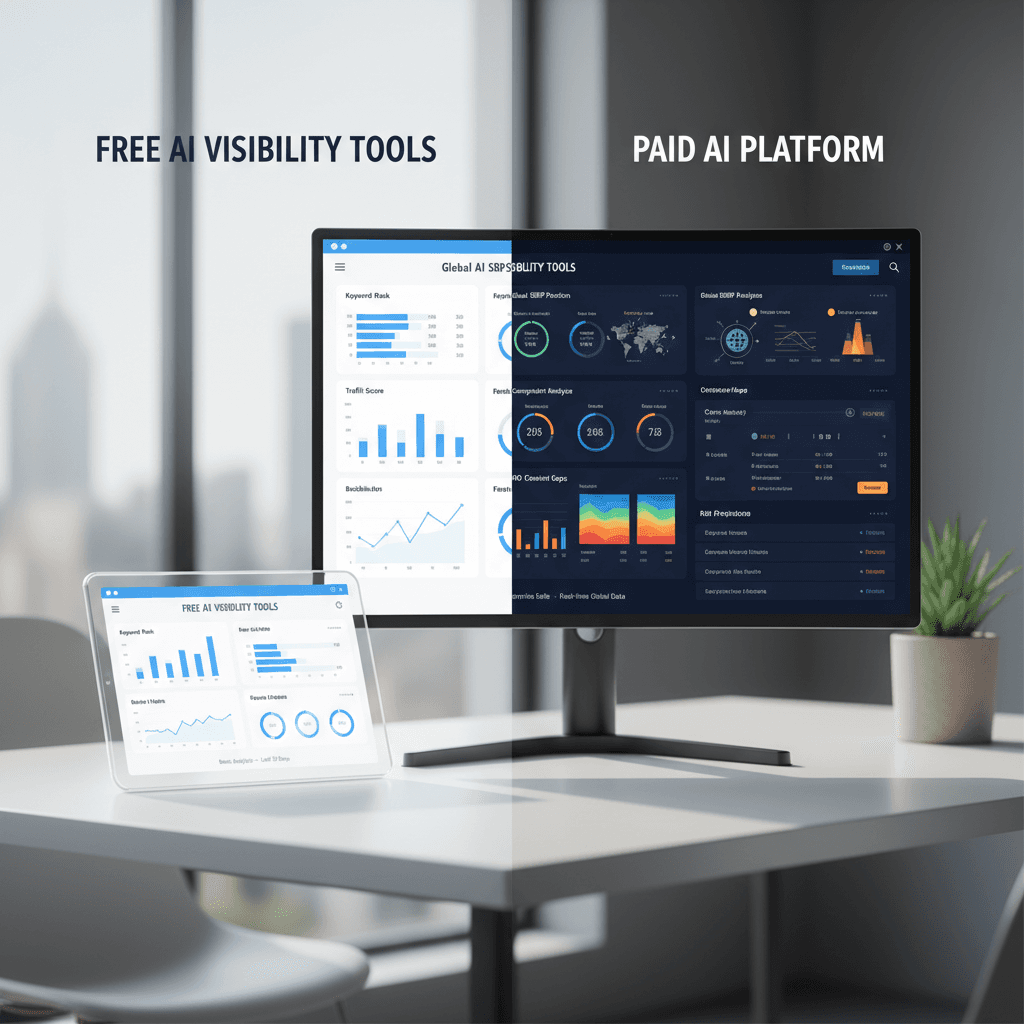
AI assistants now handle over 2 billion monthly queries globally. If your brand isn't showing up when someone asks ChatGPT, Perplexity, or Gemini for a recommendation in your category, you're invisible to a fast-growing segment of your potential customers. That's not a future problem. It's a present one.
As more businesses wake up to this reality, a natural question follows: do you need to pay for AI visibility optimization, or can free tools get the job done? We've spent considerable time evaluating both ends of the spectrum, and the honest answer is more nuanced than "free is fine" or "you must pay."
What Free AI Visibility Tools Can (and Cannot) Do
There's a genuine ecosystem of free tools that touch on AI visibility in some way. Some are purpose-built for this emerging discipline, while others are traditional SEO or analytics tools that offer partial insight into how AI systems perceive your brand.
Where Free Tools Deliver Real Value
Free tools tend to shine in a few specific areas:
Basic brand mention auditing: Tools like Google Alerts or manual prompting across AI platforms give you a rough sense of whether your brand surfaces in AI responses.
Content gap identification: Free content analysis tools can highlight where your site lacks the structured, authoritative information that AI models pull from when generating answers.
Technical health checks: Schema markup validators and structured data testing tools (many free) help ensure AI crawlers can parse your content correctly.
Prompt testing: You can manually query OpenAI's platform and other AI systems to see how your brand appears in responses, at no cost.
For small businesses or early-stage startups exploring the AI visibility landscape for the first time, these free approaches provide a legitimate starting point. The data may be incomplete, but the directional signals are real.
Where Free Tools Fall Short
The limitations become clear quickly once you move past surface-level auditing. Free tools generally can't:
Track your AI visibility systematically over time across multiple platforms
Benchmark your brand against competitors in AI-generated responses
Provide structured recommendations tied to specific AI ranking factors
Automate the monitoring process at any meaningful scale
Manual prompting across ChatGPT, Gemini, and Perplexity is time-consuming and inconsistent. The sample sizes are small. And without a repeatable process, you can't tell whether your visibility is improving or declining. That's the core limitation of cobbling together free AI visibility tools: they give you snapshots, not intelligence.
Platform Comparison: Free vs Paid Features
To make this feature analysis concrete, here's how free and paid approaches typically stack up across the dimensions that matter most for AI visibility work:
Feature | Free Tools | Paid Platforms |
|---|---|---|
Brand mention tracking (AI) | Manual only | Automated, multi-platform |
Competitor benchmarking | Not available | Included in most tiers |
Structured data auditing | Basic validators | Comprehensive, prioritised |
AI response frequency scoring | Not available | Core feature |
Optimisation recommendations | Generic / DIY | Specific, actionable |
Reporting and dashboards | Limited | Full historical reporting |
Support and guidance | Community forums | Dedicated support tiers |
The pricing comparison matters here too. Most paid AI visibility platforms sit in the range of a few hundred to several thousand dollars monthly, depending on scale. For businesses driving meaningful revenue through discovery channels, that cost is easy to justify. For very small operators, the calculus is tighter.
The Managed Services Alternative
There's a third option that often gets overlooked in the free-vs-paid binary: fully managed AI visibility services. Rather than buying software and running it yourself, you work with specialists who handle everything. At SEO is Dead, our Index Lab service operates exactly this way, doing the optimisation work on your behalf while you focus on your business.
According to research from McKinsey on the state of AI, companies that move early on AI adoption consistently outperform peers who wait. That applies to AI visibility just as directly as it does to any other AI application. Getting the execution right matters as much as getting started.
Making the Right Choice for Your Business
The free-vs-paid decision really comes down to three factors: your current visibility gap, your internal capacity, and how competitive your category is in AI-generated responses.
When Free Tools Are the Right Starting Point
Start with free tools if you're genuinely in the discovery phase. Use them to understand the landscape, test a few queries, and build a baseline picture of where you stand. This is reasonable homework before committing budget to a paid platform.
Free approaches also make sense if you're in a category where AI visibility competition is still low. Some niches haven't yet seen brands actively optimising for AI recommendations, which means even basic improvements can deliver outsized results.
When a Paid Platform Makes Clear Sense
The moment you need to track change over time, benchmark competitors, or demonstrate ROI to stakeholders, free tools stop being sufficient. Paid platforms handle the measurement and reporting infrastructure that free tools simply weren't built to provide.
For companies that want a self-serve approach without giving up sophistication, our Lua Rank platform provides the audit depth and ongoing monitoring that free tools can't match. For those who'd rather not manage it internally, Index Lab delivers the same outcomes through a done-for-you model.
A Counterargument Worth Taking Seriously
We should be fair here: some businesses genuinely don't need paid AI visibility tools yet. If your audience is primarily found through channels with no AI assistant overlap, if your purchase cycle is entirely relationship-driven, or if your category simply isn't one that people query AI assistants about, the urgency is lower. The AI discovery shift is real, but it's not uniform across every market segment or geography.
That said, the window for early mover advantage is narrowing. Insights from TechCrunch's AI coverage consistently show accelerating adoption curves. The businesses building AI visibility infrastructure now will be significantly harder to displace in twelve months.
Looking Forward
The platform comparison landscape itself will shift. As AI visibility becomes a mainstream discipline, free tools will improve and paid platforms will add more sophisticated features. We expect AI assistants to become even more dominant in product and service discovery over the next two to three years, which will push more businesses into needing proper measurement infrastructure rather than ad hoc manual checks.
The brands that treat AI visibility as a core marketing channel today, not a future consideration, will be the ones competitors are trying to catch up with tomorrow.
Frequently Asked Questions
Can free AI visibility tools replace a paid platform for a small business?
For initial exploration and baseline auditing, free tools can provide useful directional insight. However, they lack the systematic tracking, competitor benchmarking, and structured recommendations that paid platforms offer. A small business in a competitive category will hit the ceiling of free tools quickly, particularly once they need to demonstrate that their optimisation efforts are actually moving the needle over time.
How do paid AI visibility platforms differ in their pricing models?
Most paid platforms use either a subscription tier model (priced by features, query volume, or number of tracked keywords) or a managed service retainer structure. The self-serve platforms like Lua Rank tend to be more accessible for smaller teams, while managed services like Index Lab are suited to organisations that want results without building internal expertise. The right fit depends on your capacity and how central AI visibility is to your overall growth strategy.
How quickly can AI visibility improvements show measurable results?
This varies by category, brand authority, and the specific AI platforms being optimised for. In our experience, brands that implement structured content improvements and authority-building strategies typically begin seeing changes in AI response inclusion within six to twelve weeks. Tracking these changes accurately requires consistent monitoring over time, which is one reason why relying solely on manual free tool checks tends to produce inconclusive results.