SEO is Dead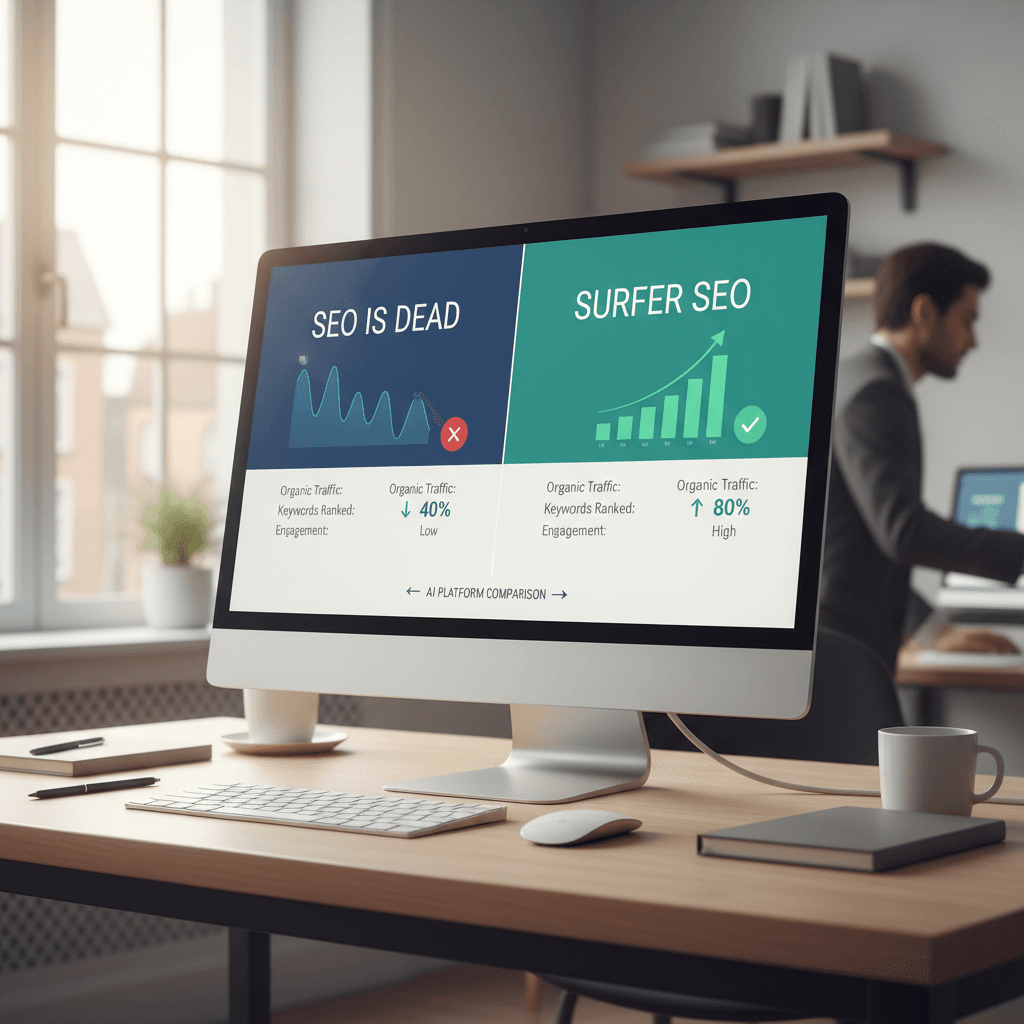
Mid-market companies face a specific challenge that enterprise brands and solo operators don't: they have real budget, real competition, and real pressure to show returns on their digital investment. Choosing the right platform to drive discoverability isn't just a technical decision, it's a strategic one. And right now, that decision has gotten significantly more complicated.
Surfer SEO has been a go-to for content teams focused on Google rankings. SEO is Dead takes a fundamentally different position, arguing that the discovery landscape has shifted beneath everyone's feet. With AI assistants like ChatGPT, Perplexity, and Gemini now handling over 2 billion queries per month, the question isn't just "which tool ranks better on Google" but "which platform prepares your brand for how people actually find things today."
This AI SEO platform comparison is designed to help mid-market decision-makers cut through the noise.
What Each Platform Is Actually Built For
Surfer SEO: Precision Content Optimization for Search Engines
Surfer SEO was built around one core idea: help writers create content that ranks on Google by analyzing top-performing pages and surfacing data-driven recommendations. Its content editor, SERP analyzer, and keyword research tools are genuinely well-designed. For teams producing high-volume blog content aimed at traditional search, it delivers real value.
The platform's strengths include:
Content scoring against existing Google results
NLP-based keyword density suggestions
On-page SEO audit capabilities
Integration with Google Search Console and popular CMS platforms
Surfer SEO is a mature product solving a well-understood problem. The issue is whether that problem is the right one to focus on in 2025 and beyond.
SEO is Dead: Built for the AI Discovery Era
Our approach starts from a different premise. Google's organic search traffic is declining by roughly 40% as AI assistants absorb a growing share of discovery intent. Optimizing for Google rankings while ignoring AI visibility is like perfecting your Yellow Pages listing in 2005. The medium matters.
SEO is Dead offers two products built specifically around this reality. Index Lab is our managed service, where we handle AI visibility optimization end-to-end for brands that want results without internal resource allocation. Lua Rank is our self-serve platform, giving mid-market teams the tools to audit how they appear inside AI systems and improve that presence over time.
The core capabilities include:
AI citation and recommendation auditing across major AI assistants
Brand visibility scoring within ChatGPT, Perplexity, and Gemini
Structured data and content strategies designed for AI training inputs
Competitive benchmarking against how rivals appear in AI-generated answers
Feature Comparison for Mid-Market Teams
A thorough feature comparison matters when you're committing budget and team time. Here's how the two platforms stack up across the dimensions mid-market companies typically care about most.
Feature | Surfer SEO | SEO is Dead |
|---|---|---|
Primary focus | Google ranking optimization | AI assistant visibility |
Content optimization | Yes (NLP-based, Google-focused) | Yes (structured for AI ingestion) |
AI citation tracking | No | Yes |
Competitive AI benchmarking | No | Yes |
Managed service option | No | Yes (Index Lab) |
Self-serve platform | Yes | Yes (Lua Rank) |
SERP analysis | Yes | Limited |
Suited for Google-first teams | Strong fit | Secondary focus |
Suited for AI-first discovery | No capability | Core product |
Where Surfer SEO Still Has an Edge
Fairness requires acknowledging where Surfer SEO genuinely outperforms. If your mid-market business relies heavily on content marketing through Google, and your audience skews toward traditional search behavior, Surfer's on-page optimization engine is more mature and more granular than anything we currently offer for Google-specific ranking signals. Its content editor workflow is also well-integrated into existing publishing processes, which matters for teams with established content operations.
The Counterargument Worth Taking Seriously
Some marketers argue that AI visibility is still too early-stage to justify redirecting budget away from Google. That's a fair concern. Google still handles enormous query volume globally. Abandoning traditional search optimization entirely would be a mistake for most mid-market businesses.
But the real risk isn't choosing one over the other. The risk is ignoring AI visibility entirely while competitors quietly build their presence in the channels where future discovery will happen. McKinsey's research on AI adoption consistently shows that early movers in technology transitions capture disproportionate market share, while late adopters spend years catching up.
Which Platform Makes More Sense for Mid-Market Right Now
The Case for Using Both (Transitionally)
For most mid-market teams, the honest answer is that this isn't a binary choice today. Running Surfer SEO for existing content production while layering in Lua Rank for AI visibility auditing covers both the present and the near future. As AI-driven discovery continues growing, the balance of investment should shift accordingly.
When SEO is Dead Is the Clear Choice
If your organic Google traffic is already declining and you're struggling to understand why, traditional platform review metrics won't surface the answer. The cause may be AI assistants intercepting queries before users ever reach a SERP. In that scenario, investing more in Surfer SEO optimizations is addressing the wrong problem.
Mid-market companies in categories like software, professional services, financial products, and e-commerce are already seeing this pattern. Users increasingly ask AI assistants for recommendations directly, and the brands those assistants cite are capturing intent that never shows up in Google Analytics. Tracking and optimizing for that visibility requires a different set of tools entirely.
The Forward-Looking View
The trajectory here is clear. TechCrunch's ongoing AI coverage consistently documents accelerating adoption of AI assistants across consumer and B2B contexts globally. Within three to five years, AI-mediated discovery will likely represent a majority share of high-intent queries in many product categories. The companies building AI visibility now will have brand recognition baked into AI recommendation systems before competitors even start auditing their presence.
This isn't a prediction about Google's demise. It's an observation that the tool selection decisions made today will compound in meaningful ways over the next few years. The mid-market companies that treat AI visibility as optional are making a bet that the behavior shift will be slow enough to catch up later. That's a bet we'd be cautious about taking.
Frequently Asked Questions
Can SEO is Dead replace Surfer SEO entirely for a mid-market content team?
Not immediately, and we wouldn't recommend framing it that way. Surfer SEO handles Google-specific content optimization well, and if your team produces high volumes of blog content targeting traditional search, those workflows have value. SEO is Dead addresses a different and increasingly important layer of discoverability: how your brand appears when AI assistants answer user questions. The more strategic move for most mid-market teams is running both in parallel during the current transition period, gradually shifting investment toward AI visibility as that channel continues to grow.
How does AI visibility optimization actually work differently from traditional SEO?
Traditional SEO works by optimizing signals that influence how Google's algorithm ranks pages, including keywords, backlinks, page speed, and structured data. AI visibility optimization focuses on how AI models perceive, cite, and recommend your brand when generating answers. This involves ensuring your brand is accurately represented in training-relevant content sources, that your structured data communicates clearly to AI ingestion systems, and that your brand appears in the contexts where AI assistants pull recommendations. Platforms like Lua Rank audit where you currently stand in that ecosystem and surface specific improvements.
Is AI SEO relevant for businesses outside the US market?
Completely. AI assistant adoption is a global phenomenon. ChatGPT, Perplexity, and Gemini serve users across Europe, Asia-Pacific, Latin America, and every other major market. If anything, businesses in markets where Google's dominance has historically been less absolute, such as parts of Asia where alternative search behaviors already existed, may find the transition to AI-assisted discovery happening even faster. The opportunity to build AI visibility ahead of competitors is just as real for companies operating internationally as it is for those in North America.